
 0
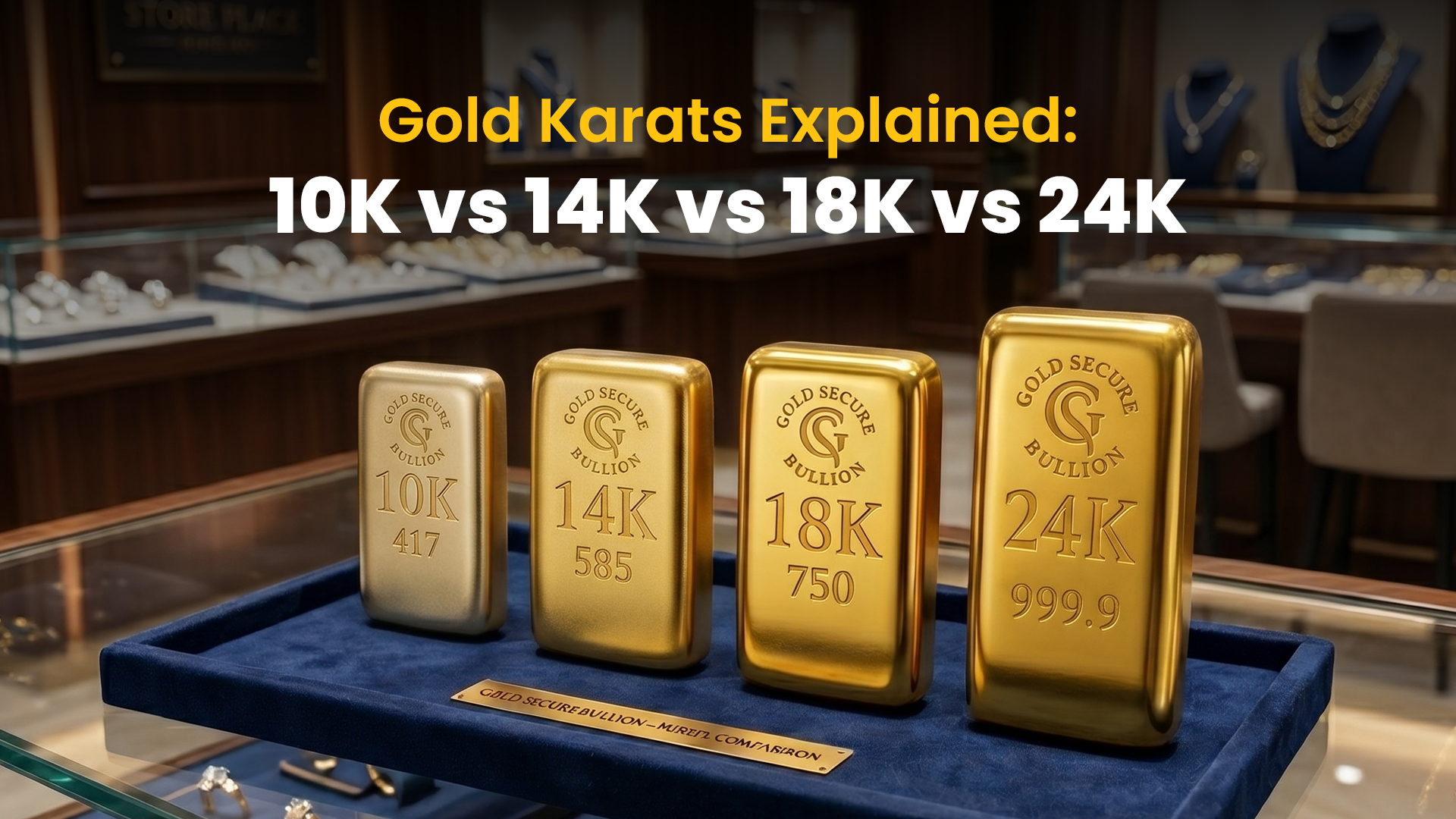
0Gold Karats Explained: 10K vs 14K vs 18K vs 24K
What do those numbers on your gold actually mean? Here’s everything you need to know about gold karats. Read on.
If you’ve ever looked at gold jewellery and seen labels like 10K, 14K, or 24K, it can feel a bit confusing at first. Most people assume higher is better, but that’s not always the full picture. Gold jewellery is made from different karats of gold, and you should know that each karat serves a different purpose. Some are better for daily wear, some look richer, and some are mainly used for investment. Once you understand what these numbers actually mean, choosing becomes much easier.
Here’s our 101 guide that explains everything you need to know about gold karats. By the time you’ve finished reading it, you’ll know exactly what 10K, 14K, 18K, 22K and 24K mean, why prices differ between them, which one suits daily wear versus investment, and how to check the karat of any gold piece you already own.
Key takeaways
- Karat measures how much of a gold item is pure gold, out of 24 parts. 18K means 18 parts out of 24 are gold, or 75% pure.
- Higher karat = more pure gold, richer yellow colour, higher price per gram, and softer metal.
- Lower karat = less pure gold, paler colour, lower price, and harder, more durable metal.
- 10K and 14K are best for daily wear jewellery — especially in physically demanding conditions.
- 18K is the fine jewellery sweet spot — beautiful colour, quality feel, and durable enough for regular wear with care.
- 22K is a traditional and culturally meaningful choice for many people worldwide across different ethnicities, particularly for ceremonial and bridal jewellery.
- 24K is pure gold — brilliant for investment, bullion, and coins, but too soft for everyday jewellery wear.
- There is no single “best” karat. The right choice depends entirely on what the gold is for and who’s wearing it.
What does gold karat mean?
Gold karat tells you how pure the gold is. Karat, written as K or kt, is the unit used to measure gold purity. Purity refers to the percentage of a gold item that is actually pure gold, rather than other metals. The karat scale runs from 0 to 24, where 24 represents pure gold with no other metals mixed in. So when you see a number like 18K or 14K, it means how many parts out of 24 are pure gold.
The easiest way to understand it is to picture a pie divided into 24 equal slices. If your jewellery is 18 karat, then 18 of the 24 slices are pure gold, and the other 6 slices are a mix of other metals, such as silver, copper, zinc, or palladium, which are blended to make the gold harder, more durable, and more suitable for everyday wear.
Quick formula: Karat ÷ 24 × 100 = percentage of pure gold. So 14K ÷ 24 × 100 = 58.3% pure gold.
Gold karat chart
Here’s a table of comparison of different gold karats for your quick reference.
| Karat | Pure Gold % | Stamp | Best Used For |
|---|---|---|---|
| 10K | 41.70% | 417 | Affordable fashion jewellery, daily wear |
| 14K | 58.30% | 585 | Everyday rings, bands, popular globally |
| 18K | 75.00% | 750 | Fine jewellery, engagement rings, gifts |
| 22K | 91.70% | 916 | Traditional Indian / Middle Eastern jewellery |
| 24K | 99.90% | 999 | Investment gold, bullion bars and coins |
Understanding each gold karat
- 10K Gold (41.7% pure gold): The strongest and most affordable option
10 karat gold contains 41.7% pure gold, and the rest is a mix of other metals, which is what makes it the hardest and most scratch-resistant of all common gold karats. You can wear 10K jewellery every single day, take it to the gym, wear it to work and more.
- 14K Gold (58.3% pure gold): The world’s most popular karat
This is one of the most commonly used types for jewellery because it offers a good balance between durability and gold content. At 58.3% gold, it has a warm, clearly recognisable gold colour that looks precious. The remaining 41.7% of other metals keep it strong enough to handle daily wear without quickly showing scratches or wear marks. That’s why many engagement rings and everyday pieces are made from 14K gold.
- 18K Gold (75.0% pure gold): The fine jewellery standard
It looks rich and yellow, but it is stronger than 24K. This makes it a popular choice for high-end jewellery. It’s a good option if you want something that looks premium but can still be worn occasionally without worry.
- 22K Gold (91.7% pure gold): Culturally meaningful
22 karat gold is 91.7% pure gold, which is very close to completely pure, with a small proportion of other metals to provide just enough hardness to make fine jewellery like necklaces, bangles, earrings and more. In countries like India, Pakistan, Sri Lanka, and the Middle East, bridal jewellery and ceremonial pieces are made in 22K because high gold purity reflects value in those traditions.
- 24K Gold (99.9% pure gold): The purest gold
24 karat gold is as close to pure gold as commercially available gold gets. It has a rich, bright yellow colour, and it carries the highest value per gram because there’s almost nothing but pure gold in it. 24K gold is the international standard for investment-grade gold, including bars, coins, and bullion traded on global markets every day.
Which gold karat is best for daily wear?
Here, we have explained the different gold karats and their suitability for your daily life. Read on.
- 10K: Perfect for people who work with their hands, exercise regularly while wearing jewellery, or want something that genuinely can’t be bothered with.
- 14K: The most popular choice for daily wear worldwide. Durable, attractive, warm gold colour, and priced reasonably as compared to other karats.
- 18K: Fine for regular wear in normal conditions. It will show fine scratches over many years of daily use, but it is a great choice for people who care for their jewellery.
- 22K/24K: Not recommended for daily wear. You should opt for these karats for special occasions, cultural ceremonies, or investment purposes.
Is 24K gold too soft for jewellery?
For everyday jewellery that you wear regularly, yes, 24K gold is too soft. Pure gold is naturally very soft. On the Mohs hardness scale, gold sits at around 2.5.
Please note that this scale is just a simple way to measure how hard or scratch-resistant a material is. It runs from 1 to 10, where 1 is very soft, and 10 is extremely hard (like diamonds).
To make that easier to understand, gold at 2.5 is roughly as soft as your fingernail. That means normal daily contact, like brushing against a desk, rubbing against other jewellery, or even regular use on your skin, can slowly leave marks, scratches, or slight dents. So while 24K gold looks beautiful and pure, it is not very practical for jewellery you plan to wear every day.
How to check the karat of your gold item
The most common and reliable way is to look for the hallmark stamp. Your gold jewellery carries a small stamp on the inside of a ring band, on a bracelet clasp, or on the back of a pendant or earring. The stamp will show either the karat marking (10K, 14K, 18K, 22K or 24K) or the numerical fineness (417, 585, 750, 916 or 999). Both are saying the same thing in different formats.
- 10K means 417 (41.7% pure gold)
- 14K means 585 (58.5% pure gold)
- 18K means 750 (75% pure gold)
- 22K means 916 (91.6% pure gold)
- 24K means 999 (99.9% pure gold)
Final thoughts
Gold karats can feel technical at first, but once you understand the basics, they become very simple to read and understand.
If you’re looking to buy investment-grade gold bars or coins in 24K or close to it, Gold Secure offers an expansive range of certified products from trusted refineries, including the Perth Mint and ABC Refinery.
And if you’re trying to understand your options before making a decision, our team is always happy to guide you through an honest, unhurried conversation.
Come in and say good day whenever you’re ready.
Get in touch
- 07 4939 0239
- [email protected] or
Visit
1. Chermside (North Brisbane)
- Address: Suite 5, 832 Gympie Rd, Chermside, QLD 4032
- Phone: 07 49 390 234
- Email: [email protected]
- Hours: Mon–Fri: 9:00 AM – 5:00 PM; Sat: 10:00 AM – 4:00 PM
- Details: Located opposite Westfield Chermside, with parking available behind the building and easy access via Hamilton Road.
2. Sunnybank (South Brisbane)
- Address: 6/409 Mains Rd, Macgregor, QLD 4109
- Phone: 07 2142 6862
- Email: [email protected]
- Hours: Mon–Fri: 9:00 AM – 5:00 PM; Sat: 10:00 AM – 4:00 PM
- Details: Conveniently located in the heart of Sunnybank, easily accessible for residents.
3. Brownsplains (South-West Brisbane)
- Address: Unit 3/3376 Mount Lindesay Hwy, Regents Park, QLD 4118
- Phone: 07 2142 6482
- Email: [email protected]
- Hours: Mon–Fri: 9:00 AM – 5:00 PM; Sat: 10:00 AM – 4:00 PM
- Details: Situated along the Mount Lindesay Highway, this location serves the south-western suburbs of Brisbane.
Frequently Asked Questions (FAQs)
1. What does gold karat mean?
It tells you how much pure gold is in the item out of 24 parts.
2. What is the difference between 10K, 14K, 18K, and 24K gold?
The difference is purity. Higher numbers mean more gold content.
3. Which gold karat is the purest?
24K is the purest form of gold.
4. Is 24K gold too soft for jewellery?
Yes, it scratches and bends easily, so it’s not ideal for daily wear.
5. Which gold karat is best for daily wear?
14K and 10K are best because they are stronger. Also, 18k and 22k are used and considered auspicious to wear in different ethnicities.
6. Why is 18K gold more expensive than 14K gold?
14K gold is 58.3% pure gold, while 18K gold contains 75% pure gold, which increases its value and price.
7. How can I tell the karat of my gold jewellery?
Check for a small stamp on the jewellery, such as 10K, 14K, 18K, or numbers like 417, 585, 750, or 916. These markings show the gold’s purity and karat level.
8.What percentage of gold is in 10K, 14K, 18K, and 24K?
10K = 41.7%, 14K = 58.3%, 18K = 75%, 24K = ~99.9%.
9. Which gold karat is best for engagement rings?
14K and 18K gold are the most commonly used choices because they offer durability, appearance, and gold purity.
10. Is 14K gold better than 18K gold?
It depends on what you prefer. 14K gold is more durable and better for everyday wear, while 18K gold contains more pure gold and has a richer gold colour.
11. Why is 10K gold cheaper than other gold types?
10K gold is cheaper because it contains a lower percentage of pure gold compared to 14K, 18K, or 24K gold.
12. Does higher karat gold last longer?
Not always. Higher karat gold contains more pure gold, which makes it softer, so it can scratch or wear down more easily.
13. Which gold karat is most durable?
10K gold is most durable because it contains more mixed metals and less pure gold, making it harder and more resistant to scratches and daily wear.
14. What is the difference between 22K and 24K gold?
24K is pure gold, while 22K contains a small amount of other metals for added strength.
Author Bio