

 0
0Volatility vs. Reality: Why Geopolitics Just Set a New Floor for Gold

If you looked at the charts this past weekend, you likely saw a sea of red. After a historic run where Gold touched A$7,768/oz and Silver spiked to A$165/oz, the market experienced a sharp, sudden contraction on Sunday.
For day traders and those holding “paper gold” (leveraged contracts), it was a disaster.
For institutional investors and physical bullion holders, it was something entirely different: A validation of the new floor.
While the price of gold corrected by roughly 9% and silver by nearly 22% in a 48-hour “leverage flush,” the fundamental drivers of this bull market have not changed. In fact, the geopolitical landscape suggests that this dip is merely a pause in a much larger structural shift.
Here is why the smart money is looking past the volatility and focusing on the reality.
1. The Numbers: A Healthy Reset
Before we discuss the why, let’s look at the what. The market had become overheated, driven by speculative traders using borrowed money. When prices began to wobble on Friday, margin calls forced these traders to sell, creating a cascade effect.
However, the recovery has already begun.
| Metal | The Peak (Jan 30) | The “Flush” (Jan 31) | Current Status (Feb 2) |
| Gold (AUD) | ~A$7,768 | ~A$7,067 | Stabilising above A$7,150 |
| Silver (AUD) | ~A$165.00 | ~A$129.78 | Rebounding to ~A$140 |
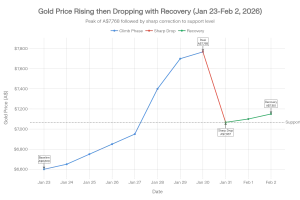
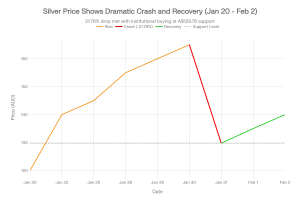
Gold and Silver Price Charts Jan 20th – Feb 2nd
The Takeaway: We have not crashed below key support levels. We have simply erased the “froth” from the last 7 days of trading. The market has found a hard floor at A$7,000—a level that was considered a “ceiling” only months ago.
2. The Main Event: Geopolitics is the Driver
The algorithms caused the crash on Sunday, but algorithms don’t run the world—governments do. And right now, the geopolitical architecture is fracturing in ways that historically benefit gold.
While traders were panic-selling on Sunday, the following realities remained unchanged:
- The Conflict Premium: Tensions in the Middle East and Eastern Europe have not de-escalated. Gold has historically acted as the ultimate hedge against kinetic war and supply chain disruption. As long as these conflicts persist, a “risk premium” is permanently priced into the metal.
- The Weaponisation of Finance: Since the freezing of sovereign assets in 2022, nations outside the G7 (the BRICS bloc) are aggressively diversifying away from Western fiat currencies. They are buying gold not for profit, but for sovereignty. A weekend price drop does not stop a Central Bank from buying; it encourages them to buy more at a discount.
- The Debt Spiral: Western governments are running deficits that require constant currency debasement to service. This is the “Fiscal Dominance” thesis. When governments print money to pay debt, hard assets repriced in that currency must rise.
The Verdict: The price dropped because traders ran out of cash. The price will rise because nations are running out of trust.
3. Silver: The Industrial Squeeze
Silver’s drop was more dramatic (21%), but so is its potential.
Silver is unique because it is not just a monetary metal; it is a strategic industrial material. It is critical for the green energy transition (solar panels), defense technology, and electronics.
The Reality Check:
- Global silver production is in a deficit.
- Above-ground stockpiles are thinning.
- China has restricted exports of strategic metals.
The weekend crash was a “paper market” event. In the physical market, you cannot simply print more silver to meet demand. At A$129–$140, silver remains fundamentally undervalued relative to its industrial necessity.
4. Technical Analysis: The “Buy Zones”
For the Australian investor, the strategy shifts from “chasing momentum” to “strategic accumulation.”
Gold Support (The Safety Net):
- Immediate Support: A$7,067. This level held firm during the crash, indicating strong institutional buying interest.
- Critical Floor: A$6,900. As long as gold trades above this level, the long-term uptrend is intact.
Silver Support (The Opportunity):
- Accumulation Zone: A$130 – A$140. With the “tourist” investors washed out, this range represents a consolidation zone before the likely next leg up in March.
5. Strategy: Don’t Trade, Position.
The events of Jan 30–31 taught us a valuable lesson: Leverage is dangerous; Ownership is King.
Investors using margin (borrowed money) were wiped out. Investors holding physical metal simply watched the price fluctuate and are now positioned for the recovery.
Suggestive Measures:
- Ignore the Noise: A 9% correction in a massive bull run is standard market health. It clears out weak hands and transfers assets to strong hands (Institutions and Central Banks).
- Watch the AUD: Remember, a falling Aussie dollar acts as a cushion for your gold price.
- Cost Average: Attempting to time the exact bottom is a fool’s game. The institutional strategy is to accumulate consistently. Buying at A$7,200 is historically safer than trying to catch a falling knife at A$6,900 and missing the boat entirely.
The Bottom Line:
The fundamentals that drove Gold to A$7,700 are still in play. The only difference is that the market is now cheaper, cleaner, and ready for the next phase.
Disclaimer: This analysis is for educational purposes and does not constitute financial advice. Precious metals markets are volatile. Ensure you are purchasing physical metals through reputable dealers like Gold Secure.