
 0
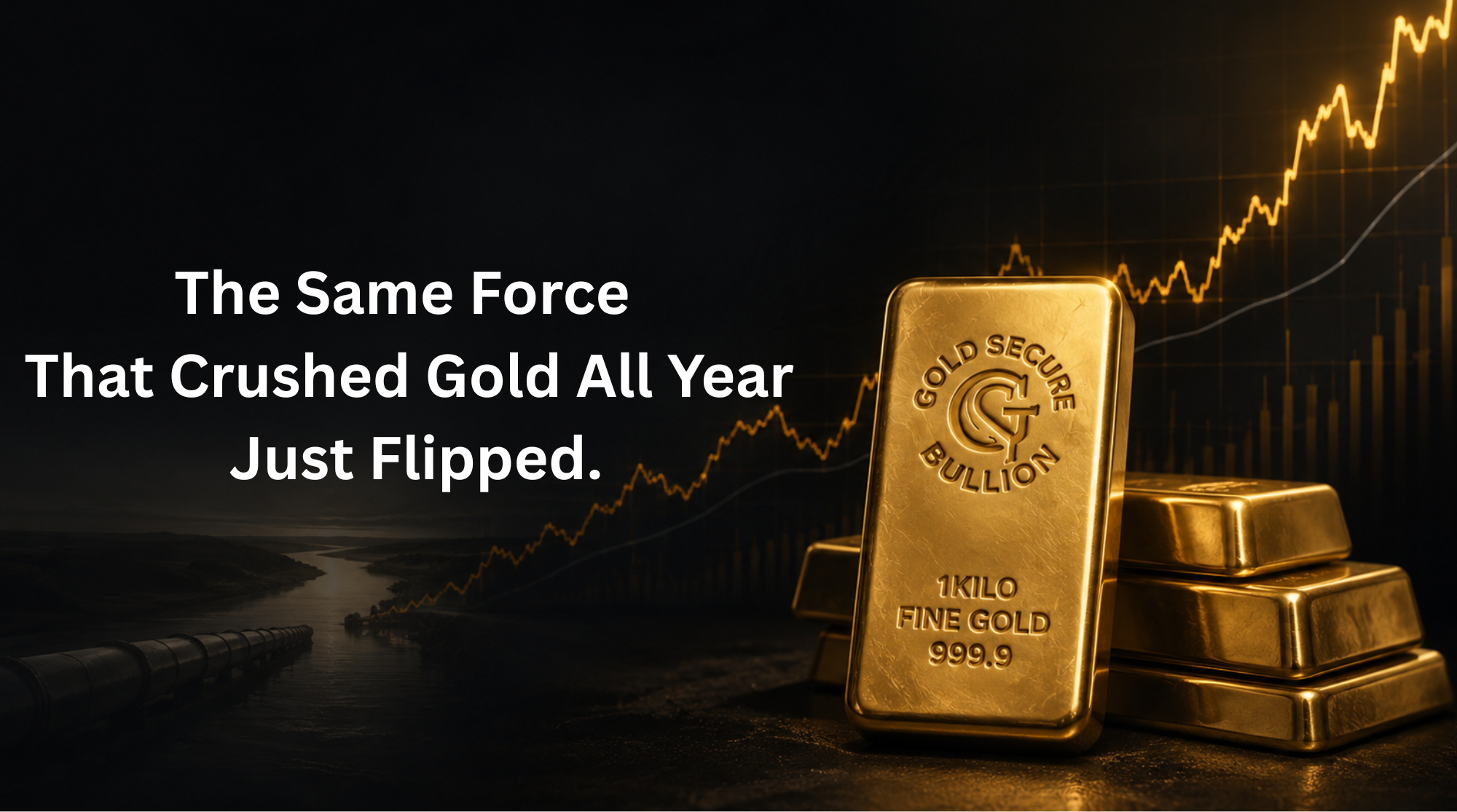
0The Same Force That Crushed Gold All Year Just Flipped.
WHAT HAPPENED THIS WEEK
Gold’s Best Week Since March.
Gold entered this week at around A$5,772 per ounce, holding the support level it had been defending for several weeks but with no clear catalyst to move higher. By Friday, it was trading near A$6,082 per ounce, a gain of nearly 6% in five days. That is the largest single-week gain since March.
Two things drove it. The first was a development in the Middle East that directly changed how markets think about inflation and interest rates. The second was a US jobs report that confirmed the economy is slowing, removing another reason for the Federal Reserve to raise rates.
Together, these two events flipped the single most important force that had been holding gold back all year.
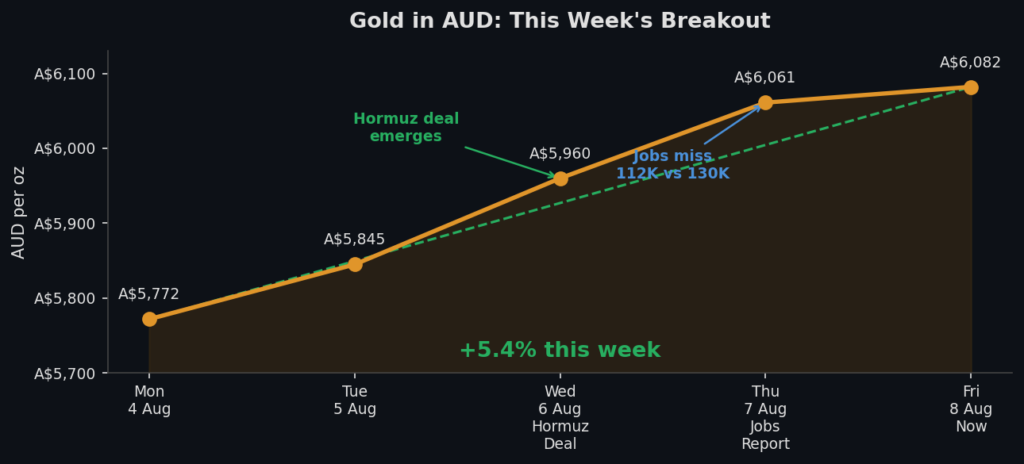
Gold in AUD across the week of 3-7 August 2026. The Hormuz deal signal on Wednesday and the jobs miss on Thursday combined to push gold up nearly 6% in a single week.
WHY IT HAPPENED
The Hormuz Chain Reaction: How It Works.
For months, one mechanism had been working against gold. Understanding it is the key to understanding why this week was different.
The Strait of Hormuz is a narrow waterway in the Middle East through which roughly 20% of the world’s oil flows. When the US-Iran conflict disrupted it earlier this year, oil prices surged. Rising oil prices meant rising energy costs for businesses and households, which fed directly into inflation. High inflation gave the Federal Reserve justification to keep interest rates elevated or raise them further. High interest rates made cash and bonds more attractive, and gold, which pays nothing, less attractive by comparison.
That chain: Hormuz blocked, oil up, inflation up, rates up, gold down. It had been running all year.
This week, Iran and Oman reached an agreement to open a designated shipping corridor through the Strait of Hormuz. Oil fell. The chain ran in reverse. And gold surged.
Falling oil pulled inflation expectations lower, which reduced pressure on the Federal Reserve to raise rates further. Gold responded immediately. A more than 4% single-day gain on Wednesday was the direct result of markets repricing the rate outlook in real time.
There is an important caveat worth being clear about. The deal is partial and contested. Iran reported fresh strikes on targets in the Strait on Friday morning, and the full terms of any agreement have not been finalised. This pattern of deal signals followed by renewed tension has happened several times since the conflict began. Markets are treating it as a genuine development, but not a done deal.
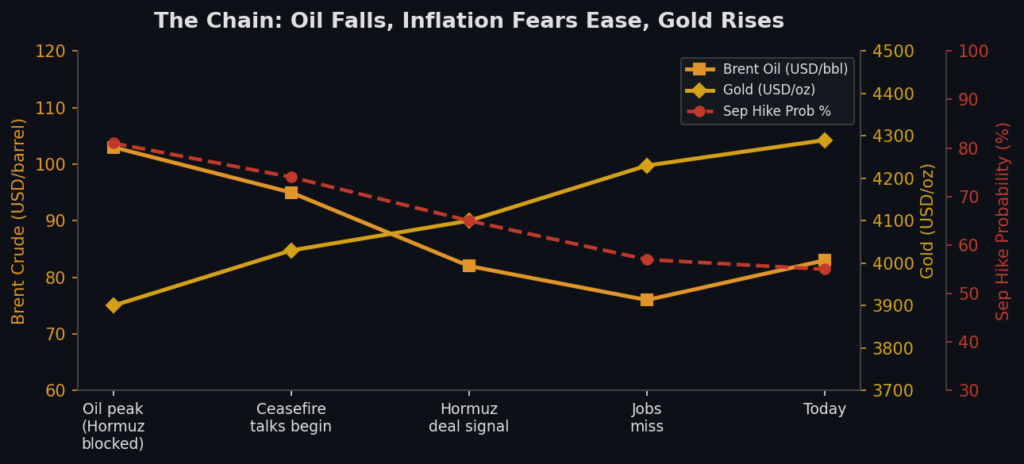
The chain reaction this week: oil fell on Hormuz deal hopes, inflation fears eased, September rate hike probability dropped from 81% to 55%, and gold moved higher in response. Note: gold and oil prices in USD for international comparison.
WHAT TO WATCH
Three Things That Decide What Comes Next.
This week’s move is real. Whether it continues, consolidates, or reverses depends on three things.
① The Hormuz deal holds and is confirmed
Watch for: Oil stays below $85. Deal terms finalised and shipping resumes normally.
What it means for gold: Gold builds on this week’s gains. September rate hike odds fall further. A$6,200 or higher becomes realistic.
② The deal collapses and tensions escalate again
Watch for: Fresh strikes in the strait. Oil spikes back above $95. Inflation fears return.
What it means for gold: Gold gives back some gains quickly. The same chain runs in reverse again.
③ The situation stays fluid, neither confirmed nor collapsed
Watch for: Oil trades in a range. September rate hike probability stays around 55-65%.
What it means for gold: Gold consolidates near current levels. Jackson Hole Fed conference in late August becomes the next major event.
The Federal Reserve’s Jackson Hole conference in late August is worth noting as the next major calendar event for gold. Fed Chair Warsh is expected to give a keynote speech that will be closely watched for signals on September’s rate decision. If the Hormuz situation has resolved by then, that speech could be the next big catalyst for gold in either direction.
The force that crushed gold all year just ran in reverse. Whether that reversal lasts depends on what happens in the Strait of Hormuz over the next two weeks.
For physical gold holders, the structural picture remains unchanged through all of this.
Central banks bought 244 tonnes in Q1 2026 alone.
China’s gold ETF inflows have now run for 14 consecutive days.
Gold remains around 20% below its January record, and the long-term case for holding physical gold as a store of value has not changed. This week simply removed one of the short-term headwinds.
DISCLAIMER
This article is for educational purposes only and does not constitute financial advice or a recommendation to buy or sell any product. The scenarios above are analytical frameworks, not predictions. Please speak with a licensed financial adviser before making investment decisions. Gold Secure Bullion is an LBMA-certified precious metals retailer.
goldsecure.com.au | @goldsecurebullion | LBMA Certified