
 1
1Oil, Rates and a Rejected Deal: Gold’s Tough Week
WHAT HAPPENED THIS WEEK
Good news for the US economy was hard on gold
Gold started last week at A$6,144/oz and finished at A$6,100/oz. On paper, that is a small dip. The week underneath it was tougher.
The Fed had just raised US interest rates for the first time since 2023. Last week, the numbers gave it reasons to keep going. US business activity grew at its fastest pace in more than five years, and fewer than 200,000 Americans filed new jobless claims.
By Friday, markets put the chance of another US rate rise in October at around 70%. The US dollar climbed to a two-month high. Silver felt it more than gold, finishing at A$91.36/oz, down from A$92.82/oz.
Then came the weekend. On Friday, Iran offered to reopen the Strait of Hormuz within seven days if the US lifted its naval blockade and eased sanctions on Iranian oil. On Saturday, President Trump rejected it.
Iran says it will not soften its terms. Oil rose and rate fears returned. On Monday, gold fell 3% in a single session to A$5,917/oz, and silver dropped more than 4% to A$87.21/oz.
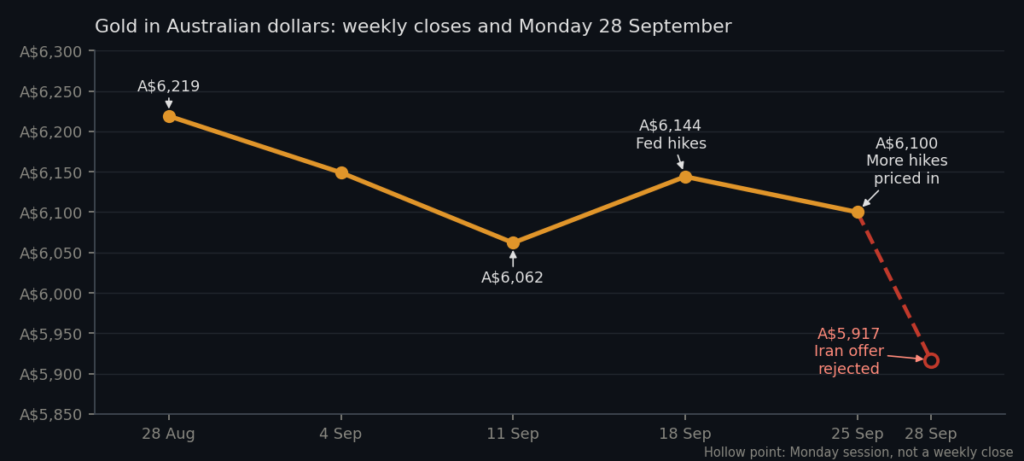
Gold in Australian dollars at each weekly close since late August, plus Monday 28 September. Gold closed at A$6,100/oz on 25 September, then fell to A$5,917/oz on Monday. AUD prices.
Every piece of good news for the US economy last week gave the Fed another reason to keep raising rates.
WHY IT MATTERS
Oil, rates and gold are one chain
Gold pays no interest. When rates rise, cash and bonds pay more, and gold faces tougher competition for investors’ money. That is why each strong US data point last week pushed gold a little lower.
Oil is what connects the Middle East to all of this. While Hormuz stays restricted, oil stays expensive. Expensive oil flows into fuel, freight, and grocery prices, and that keeps inflation high.
High inflation gives the Fed a reason to keep raising rates. So the rejected deal hit gold twice: it kept oil high, and it made further rate rises more likely. Several Fed officials have since pointed to strong growth and a solid job market as reasons more hikes may be needed.
Australians felt a softer version of the fall. The Aussie dollar slipped to around 70 US cents, and because gold is priced in US dollars, a weaker Aussie dollar lifts the local price.
Measured in US dollars, gold lost about 2% last week. In Australian dollars, the fall was under 1%.
A weaker Aussie dollar turned a 2% fall overseas into a fall of under 1% here.
Beneath the weekly swings, the long-term buyers haven’t stepped back. China imported more than 1,000 tonnes of gold in the first eight months of the year, already more than in all of 2025. Its central bank has added to its gold reserves for 22 months in a row.
WHAT TO WATCH NEXT
Three ways the coming weeks could play out
This week brings two key US reports: the Fed’s preferred measure of inflation, and Friday’s jobs report. President Trump has also said he expects talks with Iran to resume.
Scenario ① Talks restart and pressure eases
Watch for: US-Iran talks resuming with a clear path to reopening Hormuz, a softer inflation reading, or a cooler jobs report on Friday.
What it means for gold: Oil would likely ease, and so would the odds of an October rate rise. That removes the main weight on gold and gives it room to recover.
Scenario ② Strong data, no deal
Watch for: A strong jobs report, inflation above forecasts, oil staying high and US bond returns climbing further.
What it means for gold: An October rate rise would look close to certain, and gold would likely stay under pressure. A weaker Aussie dollar could soften the fall for Australian buyers.
Scenario ③ Escalation in the Gulf
Watch for: Renewed military strikes, fresh attacks on shipping or Gulf oil facilities, or firmer signals about US action after the November midterms.
What it means for gold: Two forces would pull in opposite directions. Safe-haven buying tends to lift gold, while higher oil lifts rate expectations. In recent weeks, the rate side has won, but a sharp shock can change that quickly.
These are analytical frameworks for understanding market conditions, not financial advice or predictions.