
 0
0The Wild Move: Why the Shakeout Doesn’t Change the Story
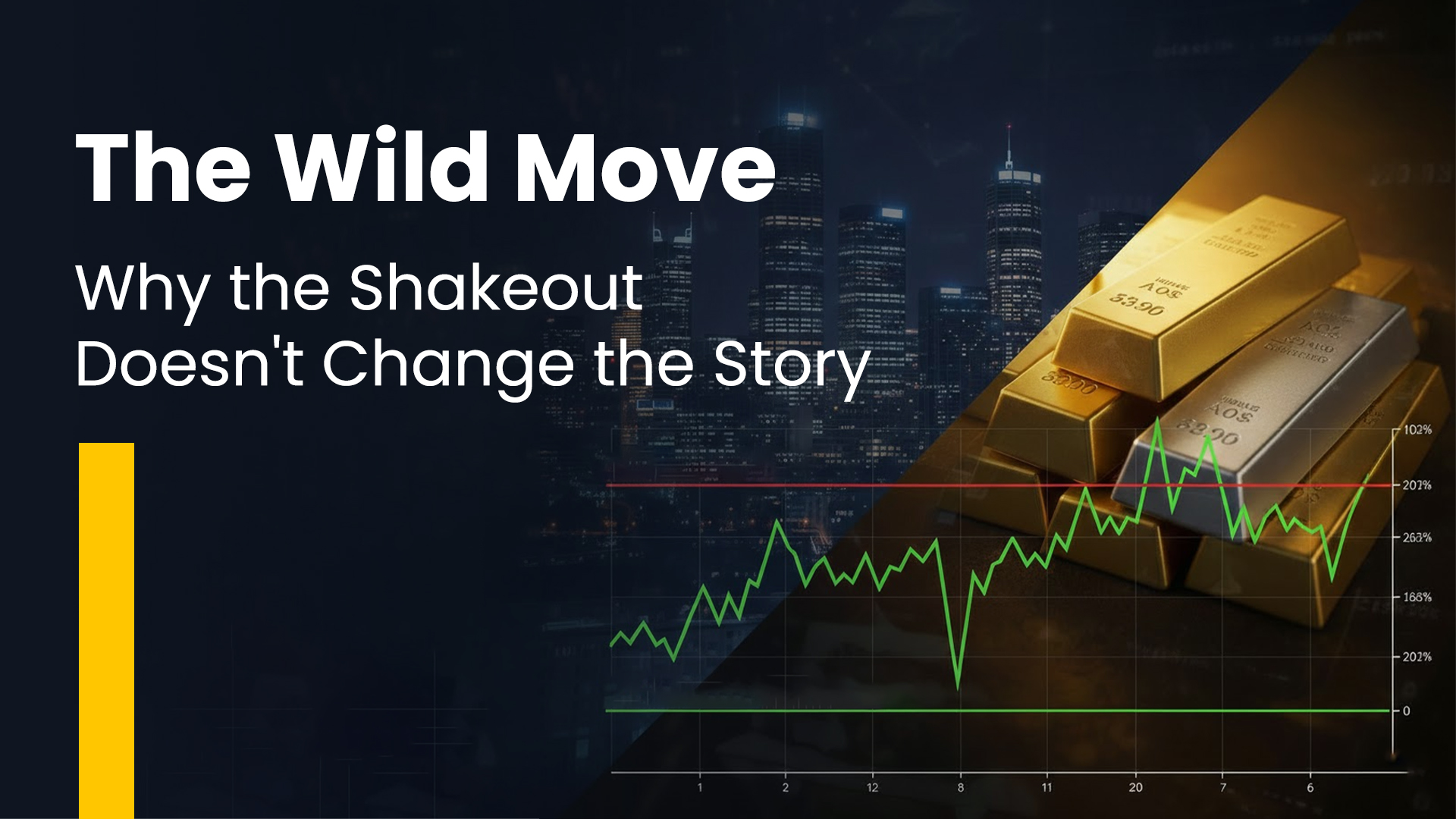
Gold went on a tear into late January, charging toward the A$7,600–A$7,700/oz zone before the market finally hit the brakes. Silver followed suit, surging from A$100/oz to nearly A$180/oz at its peak. Then, in a single brutal session, the air came out: gold dropped 10% from its high, and silver copped a massive 30% hit.
By early February, things settled down:
- Gold: Holding around A$7,000–A$7,200/oz
- Silver: Trading in the A$120–A$130 range
It’s still a bull market, and prices are still historically high—we’ve just lost the vertical “parabolic” slope. The real question isn’t why prices dipped (that’s just basic gravity after a huge run); it’s whether the big global shifts that started this rally are still in play.
A Market Ahead of Itself
Before we look at global politics, let’s be honest about the numbers. The market was simply stretched too thin:
- Gold: Was trading nearly 50% above its long-term average (the 200-day moving average).
- Silver: Was trading at double its long-term average at the peak.
When you’re that far ahead of the trend, all it takes is a small nudge to cause a slide. That nudge came from the US Federal Reserve, where a shift in leadership sparked fears of “higher for longer” interest rates. This pushed the US dollar up, nudged yields higher, and triggered a wave of margin calls and forced selling.
Gold’s New Role: “Outside Money” in a Fracturing World
The dip might be a headline, but the real story is that gold has fundamentally changed its role in the global financial system. Three major shifts are driving this:
1. The End of “Risk-Free” Reserves
Since the freezing of Russian foreign reserves, central banks have realised that money held in another country’s bank can be “switched off.” Gold, however, can’t be. It is a neutral asset with no counterparty risk. This is why central banks are buying physical metal at record rates—it’s strategic insulation, not a short-term trade.
2. Trade as a Weapon
Tariffs and trade disputes are no longer just about economics; they are tools of political leverage. In a world where supply chains are weaponised, gold is the ultimate “outside money.” It doesn’t rely on a government’s promise or a friendly relationship with a trade partner.
3. The Slow-Motion “De-dollarisation.”
While the US dollar isn’t disappearing tomorrow, more countries are looking for alternative ways to trade. Gold is the one asset everyone can agree on. It doesn’t belong to Washington, Beijing, or Brussels. When the global system fragments, that neutrality is priceless.
Silver: The Critical Minerals Race
Silver is even more interesting because it lives in two worlds. It’s a monetary metal like gold, but it’s also an essential industrial component for:
- Solar panels and renewables
- EVs and 5G tech
- High-tech manufacturing
Governments are now talking about stockpiling critical minerals the same way they do fuel. Silver sits right in the middle of this “energy transition” story. The recent price crash didn’t change the fact that we need more silver than we can currently mine; it just cleared out the speculative “froth” and gave the market a reset.
The Bottom Line
The takeaway is clear: we are in a geopolitically driven bull market. These markets periodically overshoot and then snap back violently to clear out the leverage and the hype. The fundamentals, sanctions risk, tariff wars, and the push for hard assets haven’t changed. In fact, they’re arguably stronger now than they were six months ago.
Prices will always bounce around day-to-day, but the big money is looking at the long game. Modern geopolitics is pulling capital back toward hard, unsanctionable assets. The latest shakeout wasn’t the end of the story; it was just a breather.