
 0
0Gold Is Waiting. Here Is What It’s Waiting For.
WHAT HAPPENED THIS WEEK
Gold Went Up. Then It Came Back Down.
Gold started the week around A$5,812 per ounce. By Wednesday it had climbed to around A$5,939 — its best level in a couple of weeks. Then, on Thursday, it fell back to around A$5,810, giving up almost all of the week’s gains in a single session.
Two very different things drove those two moves. Understanding both is the key to understanding where gold sits right now.
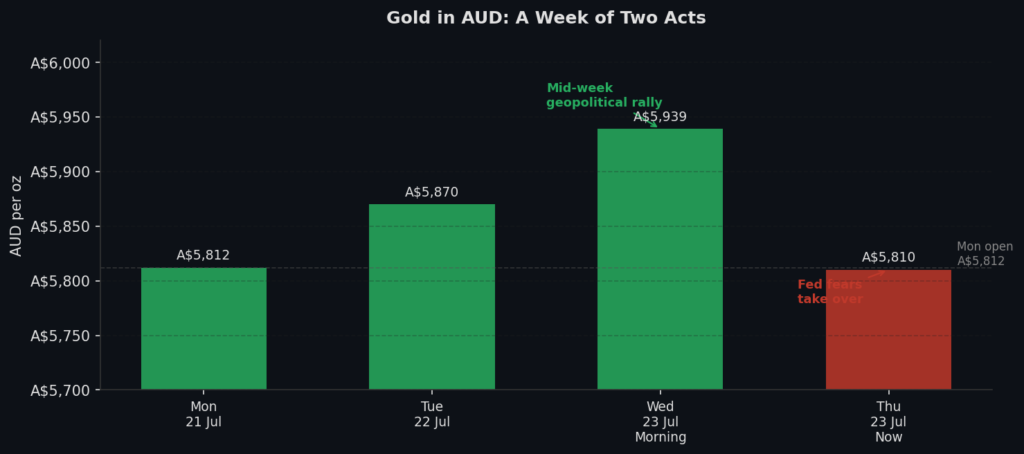
Mid-week gains driven by Middle East tensions were reversed on Thursday as attention shifted to next week’s Federal Reserve meeting.
The mid-week rise came from fresh tension in the Middle East. There were new warnings of further strikes on Iran, and a group called the Houthis announced they would target shipping near Saudi Arabia. This raised concerns about oil supply — and when oil supply looks uncertain, investors often move money into gold as a safe place to hold value.
But by Thursday, the conversation had shifted entirely. Markets started focusing on next week’s US Federal Reserve meeting — and the possibility that interest rates could go up again. When that expectation builds, gold tends to fall; read more.
WHY RATES MATTER FOR GOLD
This Is the Bit Worth Understanding.
The Federal Reserve is the US central bank. It sets interest rates — the cost of borrowing money. Those rates have a direct effect on gold, and here is the simple version of why.
When interest rates are high, you can earn a decent return by simply keeping money in a savings account or government bonds. Gold does not pay any interest or dividends. So when rates are high, gold has to compete with assets that do pay a return — and that creates pressure on its price.
When rates are low or falling, cash earns very little. Gold starts to look more attractive by comparison. That is when gold tends to do well.
Gold does not pay interest. When interest rates rise, cash and bonds become more competitive. That is the simple reason gold fell on Thursday.
Right now, markets think there is roughly a 63% chance the Fed raises rates again in September. That is up from about 38% just two weeks ago after some encouraging inflation data came through. As that probability has risen, gold has come under pressure.
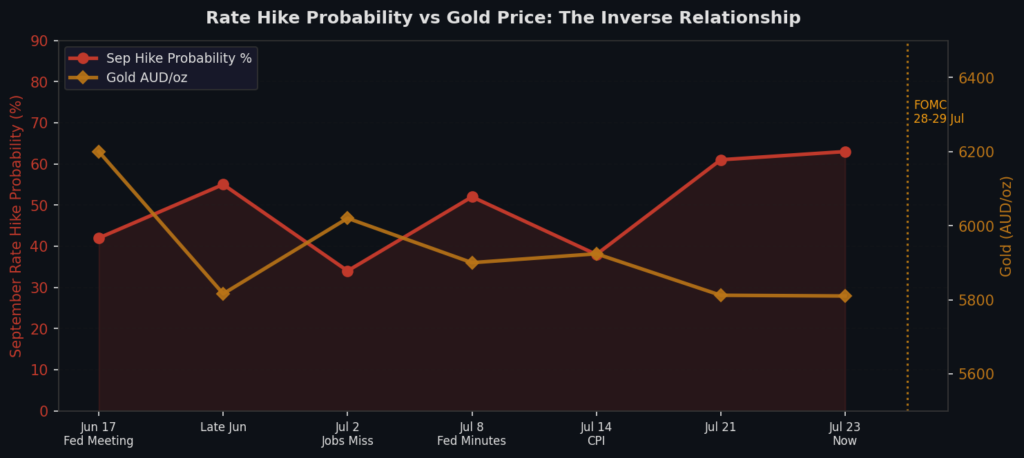
The higher the probability of a Fed rate hike, the more pressure on gold. This chart shows that relationship clearly since the June Fed meeting. The next meeting is 28-29 July.
The frustrating part for gold holders this week is that inflation has actually been coming down. Three separate government reports measuring prices all came in better than expected recently. That should mean less pressure on the Fed to raise rates — which should be good for gold.
But there is a catch. Oil prices are still elevated because of the Middle East situation. And oil prices feed directly into next month’s inflation figures. So markets are nervous that the good news on inflation might not last. Until that picture clears, gold is stuck in the middle.
WHAT TO WATCH NEXT WEEK
Three Things That Could Move Gold.
The Federal Reserve meets on Tuesday 28 and Wednesday 29 July. Most people expect rates to stay on hold — but what the Fed Chair says after the decision will matter more than the decision itself. His words will either ease fears about future rate rises, or confirm them.
Here are three ways next week could play out.
① Fed sounds less worried about rates
Watch for: Fed Chair uses calm language. No strong signals about September.
What it means for gold: Gold likely recovers toward A$5,900 or higher.
② Fed sounds more concerned about inflation
Watch for: Fed Chair hints that another rate rise is possible. September stays live.
What it means for gold: More pressure on gold. Could test A$5,600 to A$5,700.
③ Middle East situation escalates sharply
Watch for: Fresh conflict or oil supply disruption. Safe-haven demand surges.
What it means for gold: Gold could move quickly in either direction. Unpredictable.
Whatever happens next week, the bigger picture for gold has not changed. Central banks around the world are still buying gold at record levels — they bought heavily even during gold’s worst quarter in over a decade. That steady institutional demand provides a floor beneath the price that short-term volatility does not remove.
The short-term picture is noisy. The long-term case for gold is unchanged.
DISCLAIMER
This article is for educational purposes only and does not constitute financial advice or a recommendation to buy or sell any product. The scenarios above are analytical frameworks, not predictions. Please speak with a licensed financial adviser before making investment decisions. Gold Secure Bullion is an LBMA-certified precious metals retailer.