

 0
0Gold’s Wild Ride: What Really Happened in October And Why It Matters Now

Gold just pulled off something wild. In four months, it climbed from A$5,000 to A$6,700. Then, in a single day, it crashed nearly 10%. Now it’s bouncing around A$6,150 like it can’t figure out what it wants to do next. So what’s actually going on?
The Rally Nobody Expected
Gold’s 47% surge since July wasn’t some random pump. Investors were genuinely spooked. The Fed was cutting rates. Inflation was sticky. Geopolitical tensions weren’t easing. Central banks globally were hoarding gold. Real money, not just traders, was stepping in.
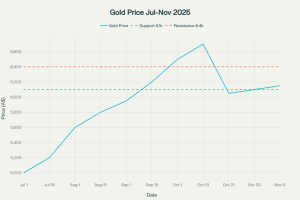
AI-generated – Gold’s Journey: Rally, Crash, and Consolidation (July-November 2025)
By mid-October, gold had broken through every resistance level. It felt unstoppable. Sentiment readings hit 93% bullish, levels not seen since 2008. Everyone was long, everyone was convinced A$7,000 was coming. That’s when you know something’s about to break.
The Flash Crash Nobody Was Ready For
October 21st. Gold dropped hard. A$700 in a day. Silver fell even worse, down A$8 in hours. Why? Profit-taking, mainly. But also a stronger US dollar and some chatter about US-China trade getting better. The thing is, none of that stuff actually matters for gold’s long-term bull case. But in the short term, when everyone’s jammed into the same trade, it only takes one thing to trigger a rush for the exits.
Here’s the uncomfortable part: when forced selling happens, traders don’t ask questions. They dump whatever’s liquid. Gold’s liquid. Silver’s liquid. So both got smashed, despite their fundamentals being solid. It’s mechanical, not rational.
Silver Shows More Fight
While gold’s been sitting around support, silver’s already bouncing. It’s up 5% from October lows and pushing toward A$75. Why’s silver recovering faster? Because the demand story is actually getting stronger. Solar panels need silver. Electronics need silver. Data centres are expanding, and they need silver. We’re looking at a supply deficit of around 845 tonnes this year—that’s real tightness, not just sentiment.
Smart money was actually buying silver when others panicked in October. That’s a good sign.
Gold’s in a Holding Pattern
Gold near A$6,150 is technically interesting. It’s sitting right in the middle of its consolidation range. A$6,100 is solid support. A$6,400 is the next resistance to watch. Here’s what matters: gold hasn’t broken down below support, and it hasn’t rallied back above resistance. It’s stuck in what traders call “tight consolidation.”
That usually means something’s about to give. The question is which way.
The Hidden Risk Everyone’s Missing
This is the thing that keeps traders up at night: the tech sector is stretched. Valuations on mega-cap AI stocks are at crazy levels. We’re talking about a rally that’s pushed earnings estimates well above long-term norms. It’s priced for perfection.
When – not if – those stocks correct, here’s what happens. Institutional portfolios with volatility limits must suddenly reduce their exposure. Fast. Across everything. They don’t pick and choose. They sell what’s liquid.
We’ve seen this movie before. April 2024: volatility spiked from calm to chaos in three days. Gold fell 6.6%. Silver crashed 17%. But both bounced back within a week.
Could it happen again? Maybe. But here’s the thing: metals have already corrected 10-15% since the October peaks. So the risk of a second forced selling shock is lower. Doesn’t mean it won’t happen, just means it’s less likely to be catastrophic.
What Gold Needs to Do
Gold’s gotta break convincingly above A$6,400 to reset higher into year-end. If it does, A$6,700 is back in play. But if it breaks below A$6,100, support collapses and we’re looking at A$5,850. That’s a 7% drop from here, which isn’t the end of the world but also isn’t fun.
Silver needs to hold A$72 and break above A$75. If that happens, A$80 is realistic into Christmas.
The key technical thing: neither metal has violated its longer-term uptrend channel. Both are just consolidating within it. That’s constructive, not bearish.
The Real Story
Here’s what matters: Gold’s bull market isn’t over. It’s just pausing.
The reasons gold rallied 47% are still valid. Inflation’s still sticky. Central banks are still buying. The US has massive fiscal deficits. Geopolitics is messy. Real interest rates are low. None of that’s changed because gold had a bad week.
What changed is that everyone and their brother got bullish, positions got crowded, and consolidation became inevitable. That’s healthy. It clears out the weak hands and lets fundamentals reassert themselves.
October’s crash wasn’t the end of the bull market. It was the most painful part of building a stronger foundation for what comes next.
What Investors Should Actually Do
Don’t chase it here. But don’t panic either. If another volatility shock forces gold below A$6,100, that’s a gift. That’s when you buy. Long-term investors should be thinking about accumulation on dips, not chasing rallies.
Gold’s consolidating between A$6,100 and A$6,400. That range is your trading zone. Break above it decisively, and bulls are back in control. Break below it, and we need to reassess.
For now, the fundamentals say higher. The technicals say patience.
Disclaimer:
This content is for educational purposes only and is not financial advice. It does not constitute a recommendation to buy, sell, or hold any security or asset. Past performance does not guarantee future results.
Always conduct your own research and consult a licensed financial advisor before making investment decisions.