
 0
0Precious Metals 2026: What’s Actually Driving Each Market

Why central banks are stacking gold, why silver has a decade-long supply problem, and which metals matter this year
GOLD: Central Banks Are De-Dollarising Their Reserves
Central banks are hoarding gold in record volumes. Last quarter alone, they picked up 220 tonnes. Over the past three years, they’ve accumulated over 1,000 tonnes annually – more than double the historical average. India’s central bank now holds 880 tonnes, its largest share of reserves since 1996.
This isn’t bullish sentiment. This is policy.
Governments are rotating out of US dollars and into gold because fiscal deficits are unsustainable (US deficits are at 6% of GDP) and geopolitical fragmentation makes dollar reserves risky. Russia’s frozen assets post-Ukraine, Venezuela’s escalation this month—these events proved that dollar holdings can be sanctioned. Gold can’t.

Central Bank Gold Accumulation: The De-Dollarisation Trend
The chart shows this acceleration clearly. It started around 2021 and hasn’t slowed.
Bottom line for 2026: Central banks keep buying regardless of price movements. This creates a structural floor under the market.
SILVER: Five Years of Shortage, Now China Locks Down Supply
Silver has been in supply deficit for five straight years. In 2025 alone, demand exceeded supply by 95 million ounces. The cumulative five-year shortage adds up to 820 million ounces.
Why can’t miners just produce more? Because 70% of silver is a by-product of copper and zinc mining. You can’t scale silver production independently. Meanwhile, demand keeps rising—EVs, solar panels, and semiconductors need it.

Silver Supply Crisis: 5+ Years of Structural Deficit
Then on January 1, 2026, China declared silver “strategic” and restricted exports to just 44 approved companies. This tightens the screw further.
The result? Companies are paying A$12–15 premiums above spot prices just to secure physical metal. The supply crunch is real.
Bottom line for 2026: Expect volatility (December’s leverage will unwind), but the underlying shortage is widening, not shrinking. This supports prices long-term.
PLATINUM: Locked-In Demand for Seven Years
Platinum has something special: locked-in demand growth.
When palladium prices spiked, automakers redesigned catalytic converters to use platinum instead. Once they make that switch, they stick with it for seven years, the vehicle platform lifespan. This substitution is accelerating: 360,000 ounces shifted to platinum in 2022, 540,000 ounces in 2023.
Demand keeps growing despite EV adoption because hybrids still need catalytic converters, and tightening emissions standards require more platinum per vehicle. Platinum automotive demand is forecasted to grow 7% annually through 2026.
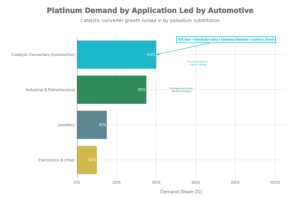
Platinum Demand Breakdown: Where the Growth Comes From
Platinum also has diversified demand with 40% from catalytic converters, 35% from industrial applications (including emerging hydrogen electrolysers), plus jewellery and electronics. This matters because the metal isn’t betting everything on one market.
Bottom line for 2026: Steady, predictable demand growth backed by locked-in automotive platforms and industrial diversification.
PALLADIUM: Vulnerable. Skip It.
Palladium’s a single-market bet. 80%+ of demand comes from automotive catalytic converters. Unlike platinum, it has no diversification and no substitution tailwinds.
As EVs grow and platinum continues to take share, palladium’s addressable market shrinks. Russia supplies most of the world’s palladium, which adds geopolitical risk on top.

Palladium vs Platinum: Contrasting Structural Outlooks
Bottom line for 2026: No new demand growth, no industrial hedge, EV adoption is a threat. Skip it unless something changes.
The 2026 Picture: Why These Metals Move Independently
| Metal | The Story | What To Expect |
|---|---|---|
| Gold | Central banks are rotating out of dollars | Structural bid intact. Dips = accumulation. |
| Silver | Five-year shortage + China export lockdown | Volatility near-term, but deficit widens. |
| Platinum | Locked-in catalytic demand + industrial diversification | Steady growth through 2026+ |
| Palladium | 80% auto catalytic demand + EV risk | Avoid. Limited upside, material downside risk. |
The Real Story
December’s silver spike, January’s Venezuela news, technical patterns—all noise.
The metals that matter in 2026 are supported by actual structural drivers:
- Gold: Reserve rotation away from dollars is accelerating
- Silver: Supply deficit is compounding; China just locked down exports
- Platinum: Seven-year locked-in demand cycle + industrial diversification
- Palladium: Single-market vulnerability
These aren’t sentiment trades. These are policy shifts, supply mathematics, and industrial demand that don’t care about chart patterns.
Respect the macro. The rest is just noise.
Educational content only. Not financial advice. Do your own research and consult a licensed adviser before investing.