

 0
0Why the Fed’s Latest Move Is Actually Gold’s Green Light

The US Federal Reserve just cut rates by 25 basis points. Markets initially cheered, then got nervous when Fed Chair Jerome Powell added a kicker: December’s cut? Not guaranteed. Not even close.
But here’s what matters for Australian gold holders watching prices sit above A$6,150/oz: the real story isn’t whether rates drop 25 points in December. It’s what’s happening beneath the headlines—and it’s all pointing toward higher gold prices, not lower.
The Fed Is Stuck Between a Rock and a Hard Place
Powell’s in an impossible spot. Employment data is softening—job gains are slowing, unemployment ticking up—which normally screams “cut rates.” But inflation? Still running at 2.8%, well above the Fed’s 2% target. Worse, goods prices are accelerating because of tariff pressures, creating what Powell himself called a “no risk-free policy” scenario.
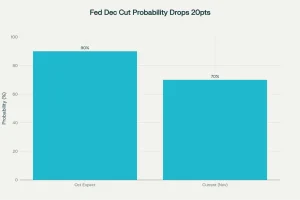
Cut too much, inflation flares up. Don’t cut enough, employment craters. The Fed’s chosen the middle path: moving toward a “neutral stance” rather than going all-in on rate cuts. Markets had priced December cuts at 90% certainty. Now it’s dropped to around 70%.
That uncertainty? That’s not a gold negative. It’s a gold positive.
The Real Win: Quantitative Tightening Ends December 1
Forget the rate-cut drama for a second. Here’s the bigger deal that barely made headlines: the Fed stops shrinking its balance sheet on December 1.
For three and a half years, the Fed has been withdrawing $2.2 trillion from the financial system, thereby draining liquidity. That’s been a structural headwind for gold because it strengthened the US dollar and made bonds more attractive. Every dollar removed made holding non-yielding gold less appealing.
That ends in five weeks.
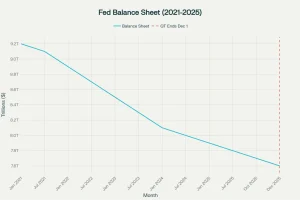
Starting December, the Fed holds its balance sheet steady. It’ll let mortgage-backed securities roll off and reinvest proceeds into Treasury bills, but the net effect is neutral. No more systematic dollar-strengthening pressure. No more structural headwind against gold.
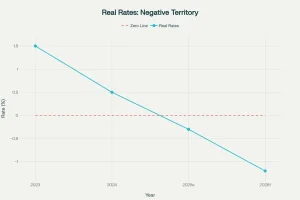
Combine that with the Fed still expected to cut another 100 basis points by mid-2026, and you’re looking at a genuine negative real rate environment ahead. That’s gold’s sweet spot—when inflation runs hotter than interest rates, gold becomes the obvious hedge.
Tariff Inflation: The Risk Nobody Can Pin Down
Powell flagged tariffs as a major wildcard. Forecasters can’t agree on how bad it gets. Vanguard thinks tariff effects peak in 2026, then fade as companies adjust supply chains. JPMorgan sees core inflation hitting 3.5% by Q4 2025 and staying sticky above 2% through 2026. Deloitte’s worst-case scenario has core PCE reaching 3.3% in 2026 as prices stay high but wage growth slows.
That last scenario—higher inflation, softer growth—is textbook stagflation risk. And stagflation is where gold thrives. It’s not a collapse, it’s not a boom—it’s the messy middle where traditional assets struggle and hard assets shine.
Central banks get this. That’s why they’re buying gold at rates we haven’t seen in decades.
Central Banks Are Hoarding Gold Like It’s Going Out of Style
Global central banks are on track to buy roughly 900 tonnes of gold in 2025—the fourth straight year of heavy accumulation. To put that in perspective: annual global gold production is around 3,000-4,000 tonnes. Central banks are claiming 20-30% of yearly supply.
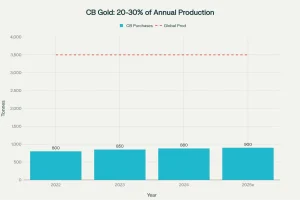
This isn’t short-term panic buying. Surveys show 76% of central banks expect to hold more gold five years from now, while 73% expect the US dollar’s share in reserves to shrink. They’re diversifying away from USD, hedging geopolitical risk, and protecting against scenarios where real returns turn deeply negative—exactly the environment we’re heading into.
When the world’s biggest financial institutions are systematically removing supply from the market and parking it in vaults, it creates a price floor. Even when gold corrected 10% in mid-October, central bank buying absorbed the weakness. That’s why the bull market held.
Australian Demand Booms
Globally, institutional buyers are driving gold’s structural bid. Locally, Australian retail demand has exploded. Transaction volumes and gold savings account sign-ups are running 6-10 times normal levels.
The Perth Mint reported a 75% surge in weekly foot traffic. Existing customers aren’t just adding exposure—they’re doubling position sizes, even after gold hit all-time highs in AUD terms.
This isn’t FOMO from amateurs. These are Australian investors who’ve watched October’s volatility—the super spike to records, the 10% flash crash, the consolidation—and decided the risk-reward still favours accumulation at A$6,150/oz.
They’re not wrong.
October Delivered the Bull Market Playbook
Here’s what October looked like: gold surged to records above A$6,150/oz. Then it corrected sharply, dropping 10% intraday—the steepest pullback in twelve years. Weak hands panicked and sold. Then the market stabilized, consolidated, and held support.
That’s exactly how bull markets work. They don’t go up in straight lines. They spike, correct violently to shake out weak conviction, consolidate while smart money accumulates, then grind higher. October was textbook.
Silver’s behaviour confirms the thesis. It’s holding above A$75/oz despite the volatility, supported by tight London markets and genuine industrial demand from EVs, solar, and semiconductors. When both gold and silver hold support after sharp corrections, it’s a signal the underlying bid is structural, not speculative froth.
What This Means for Australian Investors
Let’s cut through the noise. The Fed isn’t turning hawkish—it’s turning cautiously dovish. Rates are coming down, just not as fast as markets initially hoped. But quantitative tightening ending December 1 removes the structural headwind that’s been capping gold for years.
- Real rates are heading into negative territory.
- Central banks are buying 900 tonnes annually.
- Tariff-driven inflation creates genuine stagflation risk.
And Australian retail investors? They’re backing up the truck at A$6,150/oz because they understand the setup.
Here’s the thing about October’s 10% correction: it was necessary. Markets don’t move higher without pain. The flash crash cleaned out weak hands and let patient accumulators build positions at better levels. If you sold during that dip, you made the classic mistake—selling at precisely the wrong time.
The fundamentals haven’t changed. If anything, they’ve strengthened.
- The Fed’s policy stance is accommodative, but not overly so.
- The balance sheet stabilizes next month.
- Central bank demand isn’t slowing.
- Geopolitical risk remains elevated. And inflation? It’s not going quietly.
That A$6,150/oz level isn’t a peak. It’s a waypoint. For Australian investors aligned with global institutional positioning—central banks, sovereign wealth funds, pension funds—this consolidation phase after October’s correction is exactly where you want to be accumulating, not exiting.
Volatility will persist into 2026. But so will the structural bid. The setup rewards patience, not panic. October proved that. The question now is whether you’re positioned for what comes next.
Key Takeaways:
- Fed rate cuts slowing, but quantitative tightening ends December 1—removes major gold headwind
- Real rates heading negative as inflation stays sticky above 2%
- Central banks buying 900 tonnes annually, creating permanent supply reduction
- Australian retail demand running 6-10x normal levels despite record prices
- October’s 10% correction was healthy bull market behaviour, not a trend change
Disclaimer:
This content is for educational purposes only and is not financial advice. It does not constitute a recommendation to buy, sell, or hold any security or asset. Past performance does not guarantee future results.
Always conduct your own research and consult a licensed financial advisor before making investment decisions.