0
Inflation won October. Gold paid the price.

WHAT HAPPENED IN OCTOBER
A brief breather, then three weeks of pressure
The month in three stages
October began with a pause and ended with a slide. Gold opened the month at A$5,989 on 1 October and finished at about A$5,510 on 31 October, a fall of around 8%. In US dollar terms, the drop was more than 6%, gold’s second monthly fall in a row. Silver had it worse, falling about 18%.
One theme ran through the whole month: inflation. Early on, a weak US jobs report gave gold room to breathe. From mid-October, the pressure built week by week.
The table below breaks October into three stages: what happened in each, and how gold responded.
| When | What happened | What it meant for gold |
|---|---|---|
| Early October |
|
|
| Mid October |
|
|
| Late October |
|
|
The final trading day summed up the month. On 30 October, a sharp fall in US shares pushed investors to sell what they could for cash. Gold was caught in it and closed at its lowest level of the month.
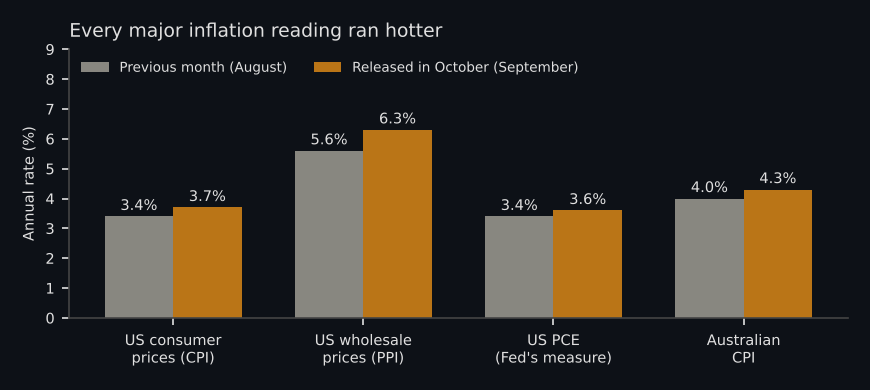
Annual inflation rates released in October 2026, against the month before. Sources: StoneX (US CPI, PPI), Kitco (US PCE), Australian Bureau of Statistics (Australian CPI).
A weak jobs report bought gold a few days. Inflation took the rest of the month.
WHY IT MATTERS
Rate fears, oil and a stronger dollar
How October's news reached the gold price
Gold pays no interest. When interest rates rise, cash and bonds pay more, so gold faces tougher competition. Each hot inflation reading made a December US rate rise more likely. By 30 October, markets put the chance of one at about 75%.
Oil fed that pressure. The conflict involving Iran has disrupted shipping through the Strait of Hormuz, a key route for the world’s oil, for much of 2026. Dearer fuel lifts inflation, and higher inflation keeps rate rises on the table.
In October, conflict worked against gold, through oil and inflation, rather than lifting it as a safe haven.
Silver, platinum and palladium are part precious and part industrial, so they felt rate fears and growth worries at once, which is why they fell harder than gold.
What it means for Australian buyers
Australia had its own version of the story. Fuel helped push local inflation to 4.3%, and markets now expect the Reserve Bank to lift rates on 3 November, which would be its fifth rise this year. Those expectations pushed the Australian dollar to its highest level since late September.
That matters for local prices. Gold is traded around the world in US dollars, so when our dollar strengthens, each ounce costs fewer Australian dollars. That is why gold fell further here in October than overseas: about 8%, against more than 6%. It deepened the fall for local holders, and made gold cheaper for anyone buying in.
Local buyers have shown how they respond to lower prices. In September, as prices fell, Perth Mint gold coin and bar sales nearly doubled from August.
WHAT HELD FIRM
The steadiest buyers didn’t step back
Central banks and the long view
Underneath October’s selling, the steadiest buyers stayed put. Central banks plan their reserves over decades, not weeks, so short-term price swings rarely change their plans.
China’s central bank added 23 tonnes in September, its 23rd straight month of buying, taking its purchases this year to 103 tonnes.
Not every central bank is buying. Russia has sold gold for ten straight months. Even so, official buying remains one of the clearest supports under the gold price.
WHAT TO WATCH IN NOVEMBER
Three ways November could play out
Frameworks, not forecasts
Scenario ① Softer data eases the pressure
Watch for: A weaker US jobs report on 6 November, cooler US inflation figures in mid-November, or progress towards a Hormuz deal that brings oil down.
What it means for gold: Bets on a December rate rise could ease, which has tended to take pressure off gold.
Scenario ② Hot data keeps gold under pressure
Watch for: Strong US jobs and inflation figures, oil staying high, and the Fed signalling a rise at its 9 December meeting. An RBA rate rise on 3 November could lift the Australian dollar further.
What it means for gold: Gold could stay under pressure, with a stronger Australian dollar adding to it for local buyers.
Scenario ③ Wildcards
Watch for: China’s October gold buying figure, due by 7 November, festival buying in India around Diwali on 8 November, and any further sharp sell-off in share markets.
What it means for gold: Each of these could move prices sharply in either direction, so short-term swings may stay large.
Check live gold and silver prices, shop bars and coins at goldsecure.com.au, or visit our Chermside store.
Sources

Prices: Guardian Gold (1 Oct, AUD). 31 Oct month-end price calculated from Kitco's late 30 Oct gold price (US$3,879.90) and the RBA's 30 Oct AUD/USD rate (0.7040). Monthly change: Kitco, TradingKey (30 Oct). US data: StoneX Precious Metals Front Desk (2 to 30 Oct); Kitco (23, 28, 29 and 30 Oct); The Rio Times (28 and 30 Oct); TradingKey (30 Oct). Australia: Australian Bureau of Statistics (28 Oct); RBA and Pound Sterling Live (AUD/USD). Demand: Perth Mint (7 Oct); Kitco/Sucden Financial (28 Oct); Kitco/Heraeus (26 Oct). Calendar: BLS via financecalendar.com (6 Nov jobs report).

This article is for educational purposes only and does not constitute financial advice or a recommendation to buy or sell any product. The scenarios above are analytical frameworks, not predictions, and past performance is not a reliable indicator of future performance. Please speak with a licensed financial adviser before making investment decisions.
goldsecure.com.au