0
Rate fears push gold to a 14-month low
WHAT HAPPENED
One strong report after another
Why gold’s election bounce has faded
Gold started November with a lift. Democrats won both houses of Congress on 3 November, US interest rates eased and gold had its best day since August.
Since then, the US data has kept coming in strong. US employers added 165,000 jobs in October, far more than the 65,000 expected. Last week, US inflation came in higher than forecast, and gold fell 2.6% that day.
This week brought more of the same. US retail spending excluding cars rose 0.6% in October, above the 0.4% expected. On Wednesday, gold fell to its lowest level since September 2025.
Gold is now at A$5,634.73 an ounce, with silver at A$68.60.
Every strong US report has added to the case for higher rates.
WHY IT MATTERS
Rates are still in charge
Why higher US rates weigh on gold, and what has cushioned the fall
Strong jobs, prices and spending all point the same way: US interest rates are likely to go higher.
When interest rates rise, cash and bonds pay more. Gold pays nothing, so it has more competition for investors’ money. When rates are expected to fall, gold looks better again.
Markets now put the chance of a 0.25% US rate rise in December at about 96%. Two senior Fed officials said this week that more rises are likely to be needed. US 10-year bond yields are near 5.10%, and the USD is near a 19-month high.
For local buyers, the currency has helped. The RBA raised its cash rate to 4.85% on 3 November, and its minutes this week showed inflation risks still lean higher. Wages rose 1.1% in the September quarter, the fastest since late 2023. Even so, US rates are expected to climb further, and the AUD fell to a seven-month low earlier this month.
Gold is priced around the world in USD. When the AUD falls, each ounce costs more in AUD. That softens the drop for local buyers.
Oil has helped a little too. Brent crude is down about 20% in November, which takes some pressure off inflation. But the Strait of Hormuz remains a risk, with ship crossings dropping sharply over the weekend after fresh US and Iran clashes.
So who is still buying? Central banks. They bought 321 tonnes of gold in the September quarter, 42% more than a year earlier. China added about 25.8 tonnes in October, its 24th monthly purchase in a row.
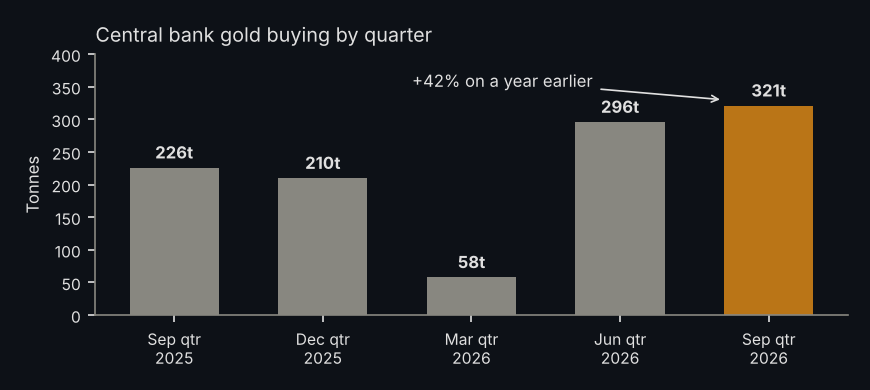
Central bank gold purchases by quarter, in tonnes.
Central banks don’t buy on weekly headlines. They buy on decade-long plans.
Their buying tends to support gold when short-term traders sell.
WHAT TO WATCH NEXT
Three paths from here
Scenario ①: Pressure eases
Watch for: Softer US inflation data on 25 November, weaker US jobs numbers, or progress on reopening the Strait of Hormuz.
What it means for gold: Rate rise expectations ease, and gold has room to recover.
Scenario ②: Rates bite harder
Watch for: The Fed’s meeting minutes, out on 19 November, pointing to several more rises, or US bond yields holding above 5%.
What it means for gold: Cash and bonds look more attractive, and gold may struggle to win back lost ground.
Scenario ③: Wildcards
Watch for: Further US and Iran clashes, Australia’s October jobs data on 19 November and inflation data on 24 November, or the RBA’s meeting on 7 to 8 December.
What it means for gold: Any of these could move gold either way. The AUD will shape how much of the move local buyers feel.
These are analytical frameworks for understanding market conditions, not financial advice or predictions.
This article is for educational purposes only and does not constitute financial advice or a recommendation to buy or sell any product. The scenarios above are analytical frameworks, not predictions. Please speak with a licensed financial adviser before making investment decisions. Gold Secure Bullion is an Australian precious metals retailer.
goldsecure.com.au @goldsecurebullion