0
Why Gold Fell When the News Looked Good
WHAT HAPPENED LAST WEEK
Two pieces of good news, and a lower close
The data went gold’s way. The price didn’t follow.
Gold closed last Friday at A$5,952/oz. Silver closed at A$86.66/oz. Both slipped on Friday, after a week of news that would normally have pushed gold up.
Gold opened this week little changed, even after more tankers were reported hit in the Strait of Hormuz over the weekend.
Last week started badly. On Monday, President Trump rejected Iran’s offer to reopen the Strait of Hormuz. Oil jumped, and gold posted its sharpest weekly fall.
Then the data turned. On Wednesday, US inflation for August came in at 3.4%. Markets had expected 3.7%. On Friday, the US added just 29,000 jobs in September, well short of the 90,000 forecast, and unemployment rose to 4.2%.
Both reports cut the odds of another US rate hike in October, from about 70% on Monday to about 22% by Friday. Gold briefly traded above A$6,080/oz straight after the jobs report. By the close, it had given that gain back.
The usual relationship worked for about an hour. Then the bond market took over.
WHY IT MATTERS
Bond yields, not the Fed, set the tone
Why falling rate hike odds didn’t make gold more attractive
Gold pays no interest. So it competes with things that do, like cash in the bank and government bonds. When those pay more, gold looks less appealing by comparison.
Usually, softer inflation and weaker jobs give the US Federal Reserve less reason to raise rates. Investors then expect lower returns on cash and bonds, and gold benefits. That is exactly what happened in the first hour after Friday’s jobs report.
The catch is who sets which rate. The Fed sets short-term interest rates. Long-term rates are set by investors buying and selling government bonds. The yield is simply the return a bond pays each year.
Last week, the yield on a 10-year US government bond barely moved. It held around 5.25% to 5.3%, close to its highest level in about two decades. It even edged up on Friday, after the weak jobs report.
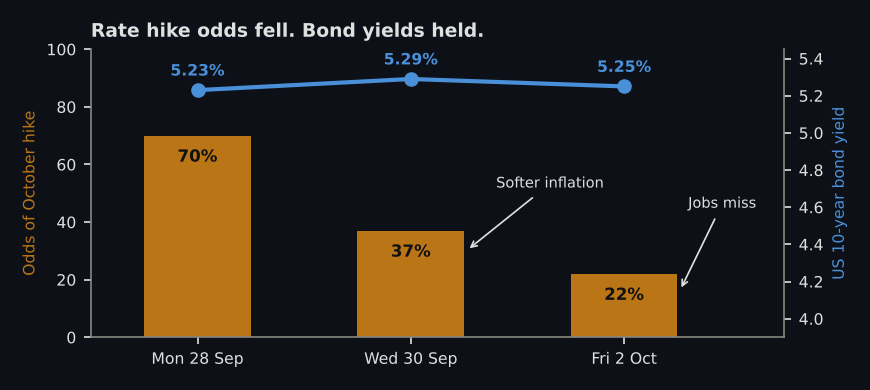
Market-implied odds of an October US rate hike against the US 10-year government bond yield, Monday 28 September to Friday 2 October. US rates shown for context; no gold prices on this chart.
Bond investors are worried about two things: inflation driven by higher oil prices, and the size of US government debt. Both make them demand a higher return for lending money over the long term. While a safe government bond pays more than 5% a year, gold has to work harder to win investors’ money.
There is a twist. The same worries pushing bond yields up, inflation and government debt, are among the main reasons people hold gold in the first place. That helps explain why gold’s fall has been smaller than the rise in yields alone would suggest.
Underneath the daily swings, central bank demand continues. China’s central bank added 20 tonnes in August, its biggest month in nearly three years and its 22nd month of buying in a row. Central banks buy on long-term plans, and that steady demand helps support gold through weeks like the last one.
The same worries pushing bond yields up are part of why people hold gold in the first place.
WHAT TO WATCH NEXT
Three ways the coming weeks could play out
The Fed’s next rate decision lands on 28 October
Scenario ①: Yields ease, gold steadies
Watch for: Softer US inflation data for September, progress in US and Iran talks over Hormuz, and oil prices easing.
What it means for gold: Lower long-term bond yields would reduce the competition gold faces. Together with steady central bank buying, that is the setup that has tended to support gold.
Scenario ②: Yields keep climbing
Watch for: Hotter inflation data, a rebound in US hiring, or Fed officials pointing to a hike before the end of the year. The 10-year yield pushing further above 5.3%.
What it means for gold: Gold would face the same pressure it did last week, and rallies would be harder to hold.
Scenario ③: Hormuz escalates
Watch for: More tanker attacks, a breakdown in talks, or military action that sends oil sharply higher. Further tankers were reported hit in the strait over the weekend.
What it means for gold: Two forces would pull in opposite directions. Safe-haven buying can lift gold, but higher oil also pushes inflation and bond yields up. In recent weeks, the second effect has often been stronger.
These are analytical frameworks for understanding market conditions, not financial advice or predictions.